
Why Omi doesn't draw your tattoo
Meta, Adobe, Canva and Fotor will generate a tattoo in seconds. Omi won't. A picture of a tattoo isn't a tattoo: it can't show how a design ages, fits your body, or whether a needle can even make it. Here's why we leave the drawing to artists.
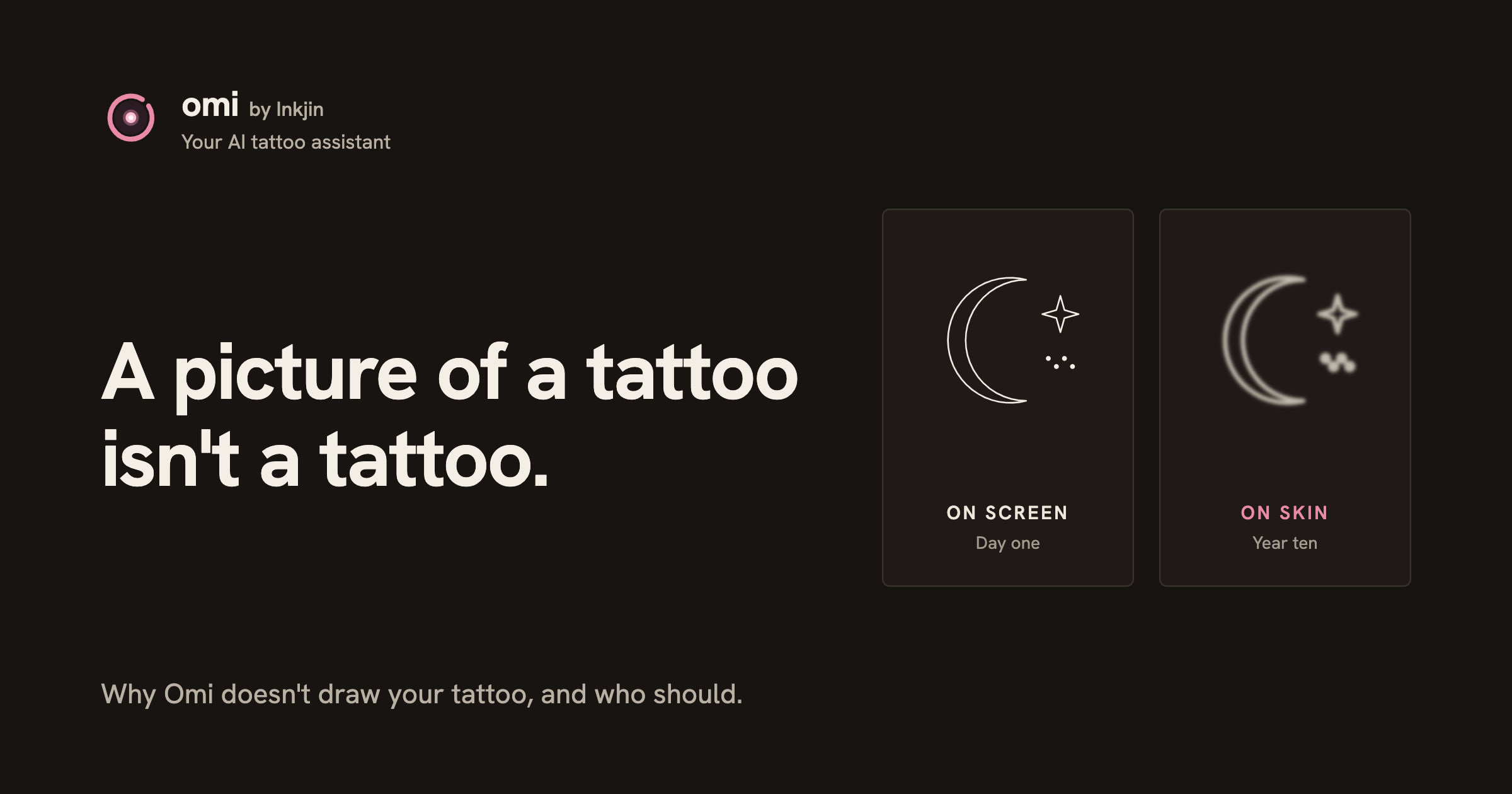
People ask us this a lot. Omi is an AI tattoo assistant, and AI tattoo generators are everywhere now. Meta has one. So do Adobe, Canva and Fotor. Type "fine line wolf, forearm, minimalist" and you get four images in a few seconds. So why doesn't Omi do that?
The short answer: a picture of a tattoo isn't a tattoo. Omi helps you work out the tattoo, and a real artist draws it.
Here's the longer answer.
What the big generators promise
In March, Meta published a guide to designing tattoos with Meta AI. Adobe Firefly, Canva and Fotor each run free tattoo generator pages. The pitch is broadly the same everywhere: describe your idea or upload a photo, and get a custom design in seconds.
Some go further than others. One of Adobe's Firefly pages promises "ready-to-ink artwork in seconds," and its FAQ says you can take the designs to an artist for refinement or use them as they are. Fotor offers to turn your photos and sketches into what it calls professional-looking tattoo designs. Canva acknowledges that a tattoo is a lifetime commitment, then says finding the design doesn't need to take long.
To be fair, Meta's guide is more careful than most. It says plainly that AI can't replace an artist's expertise, and it tells readers to have a professional review any design before it's inked. We agree with that part.
But the same guide describes its results as accurate drafts and workable designs, and every example it gives ends with the artist fixing them. The eyes are too small to tattoo cleanly. The inner lines are too dense for the placement. If the artist has to correct the design anyway, the generator hasn't done the design work. It has made a first draft that the client is now attached to.
Adobe's page even lists it as a plus that nothing you generate is permanent. That's true of the image. It isn't true of the tattoo.
A tattoo is the only thing you buy that you keep forever
Most things you buy can be returned, replaced or forgotten. A tattoo can't. It moves with your skin, it ages with you, and in twenty years it will look different from the day you got it.
So the question we built Omi around isn't "what does this look like on a screen?" It's "will you still love this in twenty years?" A generated image can't answer that. It only shows the first day.
What a generated image leaves out
An image generator makes something that looks good as a flat picture. Skin isn't a flat picture.
- Size and placement. Fine detail that looks crisp in an image can blur within a few years if it's too small. Lines set too close together can spread into each other. A design that works on a forearm may not work on a rib or a finger. An artist designs for the spot and the size from the start.
- Aging. Ink spreads a little under the skin over the years. Good tattoo design allows for that with line weight, spacing and contrast. Generators aren't designing for year ten.
- Your body. Your skin, the way that part of you curves and moves, the tattoos you already have. An artist works with all of it. A prompt knows none of it, and a mockup on a stock arm isn't your arm.
- Whether it can be tattooed at all. Some generated images have gradients, textures or tiny details that no needle can reproduce. Artists see this at once. Clients often find out at the consultation, after they've already fallen for the picture.
None of this means the images are useless. They can help you work out what you like. But a mood board is not a design. Artists see this every week: in Australia, studios told ABC News that between one in four and three in four enquiries now come with AI images, often with errors or more detail than a tattoo can hold.
Who should draw it
Just because AI can draw a tattoo doesn't mean it should. Many of these tools treat a tattoo as an image to generate. In tattoo culture it's something else: a collaboration between you and an artist, drawn for your skin and carried for life.
That collaboration has two experts. You know what the tattoo means: the person, the memory, the feeling behind it. The artist knows how to turn that into a tattoo that heals well and still looks good in twenty years. A generator skips the conversation between you. It puts the drawing in the hands of the person with the least experience, then leaves the one with the most to fix it.
The generators all follow the same order: you make the design, and then the artist adjusts it. We think that's backwards.
Artists' work, and where these images come from
There's a second reason, and it matters as much to us as the first.
Tattoo artists spend years building a style. Image models learn style from images, and many of those images are artists' work that was never offered for training. When a generator produces something "in the style of" a living artist, that artist made the style and gets nothing for it. They don't get the client either.
The guides make this easy to miss. Meta's suggests uploading tattoos you like as references, and its prompt examples include traditional Irezumi. A tattoo you like is someone's work. Irezumi is a tradition passed down through generations of artists and apprenticeships, not a style setting. Adobe says Firefly is trained ethically and is safe for commercial use, and that's better than the alternative. But a cleanly trained model still gives you the style without the artist who would have drawn it for you.
Omi is built for tattoo artists, so we've kept it simple. We don't train any AI on artists' work. Omi shows artists' public posts with their name on them, so people can find the right artist. Every design you see in Omi was made by a real person, and you can book that person.
What Omi does instead
Omi does the part software is good at, and leaves the drawing to the people who are good at it.
- It helps you shape the idea. Bring anything, from "something for my mom" to "fine line orchid, inner wrist, under €200." Omi asks the questions a good artist would ask and helps you turn a vague feeling into a clear idea. Add reference photos if you have them.
- It tells you the truth about the permanent parts. Placement, size, color, and how the piece will age. If something won't hold up, Omi says so once, then respects your decision.
- It gives you a realistic price range. Ranges come from the artist's own prices or are clearly labeled as estimates for where you live. The artist always sets the final price.
- It shows you real work. Omi has 5,400+ artists in 68 countries, 48,000 portfolio pieces and 2,700 designs ready to book. Matching is neutral: fit decides, nothing else.
- It hands you to the artist, ready. When your idea is clear, Omi puts it in one request: idea, placement, size, color, references, budget, timing. You check it, pick an artist, and press Send. The artist replies to you directly.
- The artist draws your tattoo. They draw it for your skin, your placement and your size, knowing how it will heal and age. That's their craft, and no prompt replaces it.
If you're an artist
You've probably already had the client with the generated image. Omi sends the other kind: someone who has thought about placement and size, knows roughly what it will cost, and chose you for your work.
Your portfolio on Omi is credited to you and used for one thing only: helping the right clients find you. It's never used to train a model.
Claim your profile and set your rates, your booking policies and the designs you'd love to tattoo. If you'd rather not be on Omi, you can take your profile off in a minute.
The bottom line
Meta, Adobe, Canva and Fotor have made it easy to generate a picture of a tattoo in seconds. We think that's the wrong thing to make easy.
AI can be a useful tool in tattooing. We think its job is to help you think, ask better questions and find the right person. It shouldn't stand in for the person who holds the needle.
Get the idea right. Then let an artist make it real.